
 Huawei powers Shumbasolve Phase 2 at Highveld Indu...

 Epson META-CWA Expands Renewable Energy Certificat...
 Sony’s ULT POWER SOUND Series turns up the bass ...
Africa's broadband leaders have called for a terrestrial fibre backbone that links African countries directly, cautioning that the continent's AI ambitions will stall on networks that go dark every time a single cable is cut.
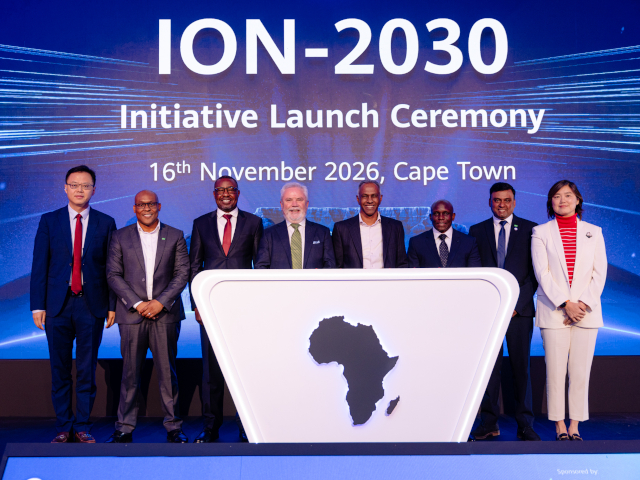
The call came at the WBBA Broadband Development Congress (BDC) Africa 2026 in Cape Town, where more than 150 government officials and industry executives met under the theme "Unlocking the Next Wave of Broadband Innovation with AI." Hosted by the World Broadband Association (WBBA) and sponsored by Openserve and Huawei, the congress also saw the WBBA launch its ION-2030 initiative in Africa.
"Africa records more than 100,000 fibre cuts a year, and every dollar invested in network resilience saves five dollars in losses," said Mr Yongqiang Yuan, Vice President, Optical Business Product Line, Huawei. "Submarine and terrestrial cables should back each other up, and mesh backbone routes should give traffic another path after a cut".
Inland countries that depend on one link across the border can lose all connectivity after a single fibre cut. To close that gap, Openserve's Executive for Carrier and Global, Mr Amu Maja, proposed an open access terrestrial backbone linking national networks from north to south and east to west.
"There's no reason why a data centre in Nigeria cannot connect to a data centre in Ghana directly," he said.
Networks that detect faults and reroute traffic automatically are the next step for the region, said Dr Jacob Munodawafa, CEO of the Southern Africa Telecommunications Association. "Let's design our future network to interconnect across our borders," he said. "Let's make it borderless".
Why AI raises the stakes
Predictive analytics can already spot the early warning signs of an outage and shift traffic while crews fix the fault, as Mr Ziaad Suleman, CEO, Cassava Technologies South Africa and Botswana, demonstrated. With just 1% of the world's data centre capacity, Africa has room to grow, and its AI models should be built for local languages and conditions. "What we as Africa cannot do is sit back and say 'it's OK, we'll use models from far away', because they don't understand your context," Suleman said.
South Africa already hosts about 70% of the continent's data centres, and with energy security restored, Eskom now has about 6 GW of surplus daytime capacity, according to Eskom Chairman Dr Mteto Nyati. "If businesses in mining, data centres or other sectors are ready to grow, we have the energy for them," he said.
China Telecom combines its cloud and network infrastructure to deliver AI on demand and wants to work with African partners on submarine cables and landing stations, said Ms Athena Jun Xian, Executive Vice President, China Telecom Global. "Customers do not need to know where the computing power comes from or where a model is deployed," she said.
Governments and operators are already building
Kenya's third National Broadband Strategy, running from 2027 to 2032, will add 100,000 kilometres of fibre to the current 70,000, connecting 6 million households and lifting broadband coverage from 13% to 60%, according to Mr Washington Okoth, Secretary, ICT Infrastructure, State Department of ICT and Digital Economy, Kenya. Kenya is also the first country where the World Bank is piloting a reverse auction for fibre, with private operators bidding to build missing links and government subsidy covering the gap. Bidding closed on 28 October, and the process is expected to deliver almost 80% of the missing links by 2032. "Without the use of the private sector, government alone actually cannot afford to ensure that the entire country is connected," Okoth said.
ION-2030 shaped the strategy's targets. Developed by the International Telecommunication Union (ITU), it is the next generation of fixed networks, and WBBA Director General Mr Martin Creaner was joined on stage by speakers and partners to launch it in Africa.
In Tanzania, TTCL's national backbone reaches about 125 of the country's 139 districts and should cover all of them by December 2026. About 60% of it is meshed for redundancy, and by April 2027 TTCL expects to connect all eight of Tanzania's neighbours to the Indian Ocean. The operator runs fibre along the national electricity utility's power poles, an approach Director General Mr Moremi Marwa encouraged others to adopt. TTCL passed about 350,000 homes last year and is building about 400,000 more this year.
From every home to every sector
More than 4 million African households were newly connected to fibre in the past year. Yuan set latency targets of 1 millisecond within metro areas, 5 milliseconds nationally and under 20 milliseconds to neighbouring countries, with 1 Gbps for every sector from schools to hospitals.
Leading operators are already following a three phase path for homes, extending fibre to the unconnected, raising speeds on existing lines and improving home WiFi, which accounts for about 70% of customer complaints. One operator lifted packages from 30 Mbps to 300 Mbps with about 7% new investment by reusing its fibre and equipment. "Let's build a bridge together," Yuan concluded.
Affordability remains the first test. Openserve's open access wholesale network gives smaller providers a route to market, according to Dr Sunil Piyarlall, Head of Business Development, Openserve. "Intelligence is only as valuable as the connection that carries it," he said. "In many parts of Africa, the immediate priority is still a dependable connection at a price people can afford".
Recognising progress
The WBBA has grown to close to 300 member companies in 60 countries, and its recent AI research includes interviews with 350 operators. "It's no good having a great access network and a weak backbone network or a good backbone network but a weak data centre network," Creaner said.
Six recipients were honoured at the Gigacity Certification and Champion Ceremony. Kenya's Ministry of Information, Communications and the Digital Economy received Gigacity Certification 2026 for advancing Konza Technopolis. Safaricom, MTN Nigeria, Openserve, TTCL and CWS were named Champions for their work in Nairobi, Lagos, Johannesburg, Dar es Salaam and Victoria.
In his closing remarks, Creaner said the WBBA would look at how it could help build a continent-wide network. "We do want to make a difference in this continent, which is the highest potential continent anywhere in the world and the one that gets us the most excited".
 MegaTel launch as first mobile virtual network operator on Telkom network
 Telkom Business takes aim at SMEs with new products
 Samsung Galaxy S4 Zoom - white
 Logitech Pebble 2 Combo
 Audi's Traffic Lights tricks now also heading to Europe
 LG’s plan to take the smart home from the kitchen to the factory floor