Cisco Relentless Defense Report reveals how AI is changing the defence game
By Ryan Noik 19 November 2026 | Categories: feature articles
Related Articles
-2.jpg) The LLMJacked cloud bill is affecting the South Af...

 Unlocking Africa’s Potential, one market at a ti...
 What can a hacker learn about your business in les...
AI is radically transforming how organisations globally and in South Africa need to approach their cybersecurity, challenging companies to stay ahead of a proliferation of cyber vulnerabilities.
And less than one in ten of those surveyed are confident they can. The challenge though, isn’t due to a lack of technology, but rather to unaddressed friction on an organisational level.
This is one of the insightful takeaways from Cisco's latest Relentless Defense report.
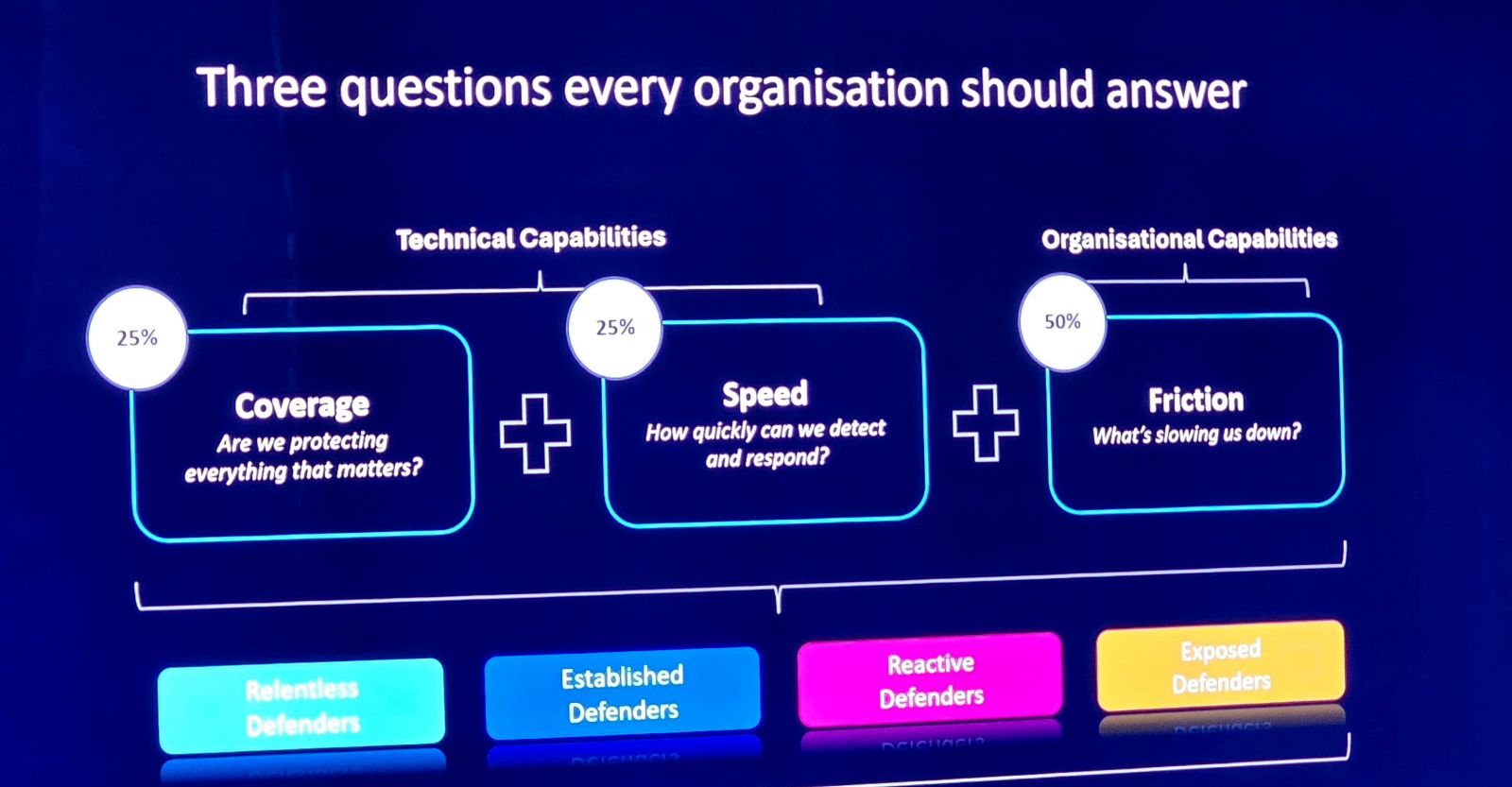
The report, which surveyed 8000 cybersecurity leaders globally, scored organisations on how completely they can protect their environment; how quickly they can detect, respond, remediate a threat, and what slows them down.
‘’Previous reports examined organisations’ preparedness and security posture; this report asks what they are doing in practice and which barriers prevent them from becoming more resilient,’’ explains Smangele Nkosi, the GM/Country Leader for Cisco South Africa.

Smangele Nkosi, the GM/Country Leader for Cisco South Africa
The advent of AI, particularly autonomous agents, is accelerating the need for companies to relook at how they improve their security, including the AI infrastructure these agents run on, and move to establishing workable defences.
The company notes that an organisation that can't coordinate a human response in a day will struggle to govern autonomous agents that proliferate cyberthreats or cause breaches in seconds.
For the Relentless Defense report, Cisco divided organisations into four camps: Relentless Defenders - those best at defending their security - (9% of those surveyed), Established Defenders (56%), Reactive Defenders (28%), and those in last place, Exposed Defenders (6%).
The new research from Cisco, which remains focused on building the AI infrastructure that the new era depends on, went further, examining how security practitioners are adapting to a threat landscape that is being reshaped underneath their feet.
To this end, the report scored organisations on how completely they can protect their environment; how quickly they can detect, respond, remediate a threat, and what slows them down. The global average score is 64 out of 100. South Africa came in slightly above this average, with a score of 68.
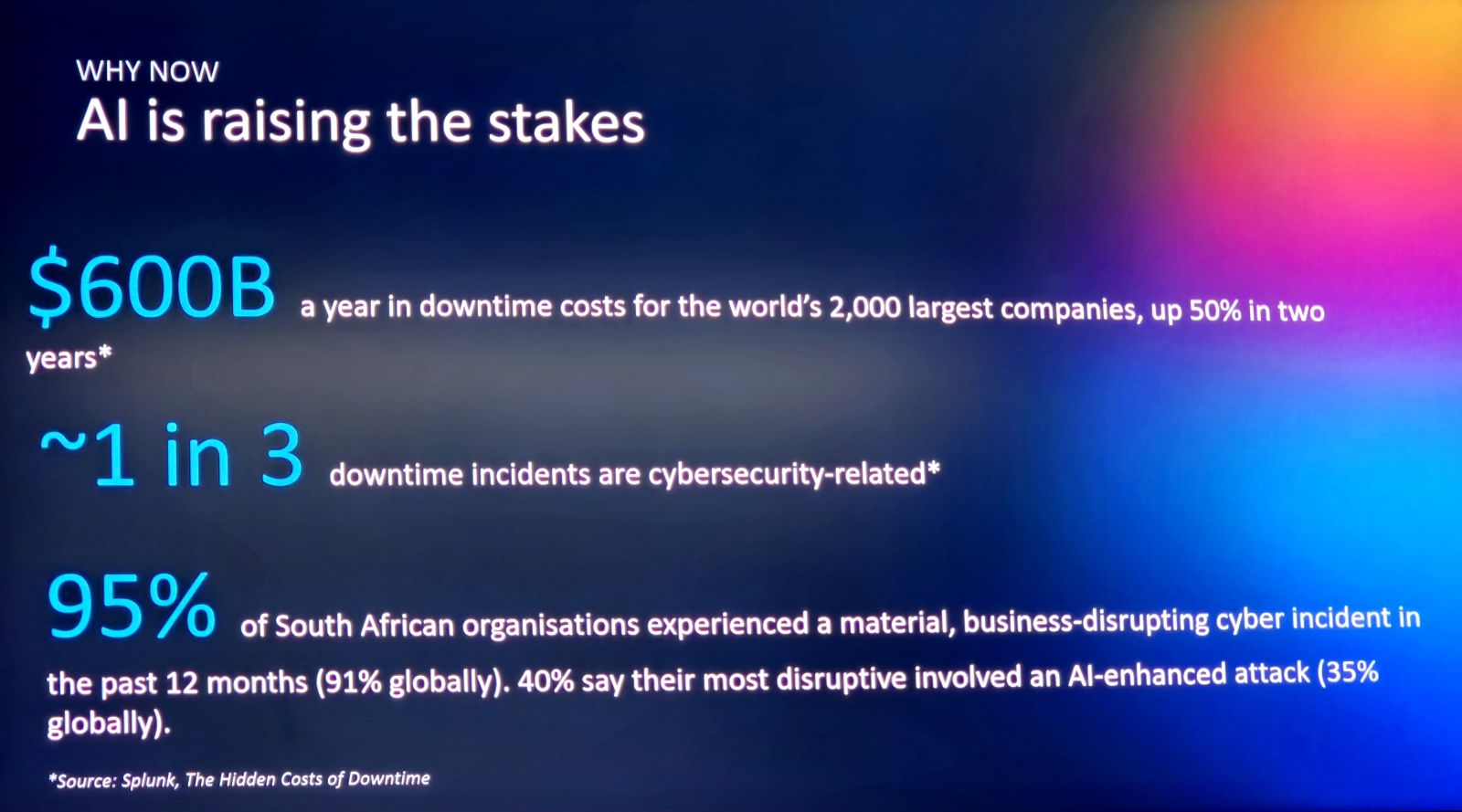
While this is heartening, and a marked improvement of cybersecurity readiness as compared with previous years, it is not cause for complacency. This is especially true considering that the report found that a staggering 95% of organisations in South Africa suffered a material, business-disrupting cyber incident in the past 12 months. More than two-thirds (40%) of those were involved an AI-enhanced attack.
Breaking barriers
The report further identified some critical barriers to better cyberdefence.
A key barrier is organisational friction. The proliferation of threats and the impact of AI means that cybersecurity defence and resilience cannot be solved by security teams alone.
‘’The real issue around cyber resilience is not the technology, it is the organisations themselves, how they are structured, their culture and to what extent the organisation operates in silos,’’ explains Nkosi. She points out that when there is an attack or a breach, its impact runs across multiple departments and arenas.
The solution is to treat cybersecurity as a business risk, and not just a technological one, but this also changes the board’s role. Nkosi argued that risk committees should examine mitigation, coverage and recovery readiness through consistent reporting and engagement with internal experts.
‘’Cybersecurity discussions must reach executive level and ultimately the board. Increasingly, boards are helping shape cybersecurity decisions, including how to build resilience and respond when threats materialise. This also brings business continuity into sharper focus,’’ she adds. The latter is of particular importance, because a cybersecurity breach can not only be costly because of the actual threat.

Nabeel Rajab, Technical Solutions Architect at Cisco South Africa
The downtime danger
There is an enormous cost that comes with downtime as well, in the region of $600 billion annually. The report found that one in three downtime incidents are cybersecurity related, with 95% of South African organisations having a cybersecurity incident that caused significant business disruption in the past year. This is even slightly higher than the global average (91%).
According to the report, South African organisations are slightly more vulnerable to AI enhanced attacks that disrupted their businesses, with 40% attributing it in South Africa as compared with the 35% global average.
As well, there is the toll that an attack takes on morale. Nkosi cites the pressure on teams expected to explain an incident, restore operations and account for losses as one ramification. Nabeel Rajab, technical solutions architect at Cisco South Africa, adds that prolonged recovery can involve weeks of strain and limited sleep, while service disruption can affect customers and other businesses.
The way to mitigate this is through sufficient preparation, with an agreed upon continuity process already in place instead of making workers improvise amid uncertainty.
Both Nkosi and Rajab stress that this approach should be embedded into the company culture, where coordinated recovery isn’t hampered by trying to assign blame.
Attackers from unexpected directions
Another finding is that because cybersecurity breaches have wide-ranging impact, they are requiring new approaches to defence. ‘’Businesses must understand where the attacks are coming from, in order to build the right protections and be able to respond in the most appropriate way, ‘’ explains Rajab.
According to the report, attackers have become craftier in how they infiltrate an organisation, with Rajab noting the uptake of supply chain attacks.
‘’This means that an organisation that an attacker has identified as being an attractive target may not be attacked directly at all. Instead, cybercriminals look at that organisation’s suppliers and customers, and then look for weaknesses in their organisation. That becomes their way into the organisation they want to target,’’ he explains.
Thus, the need for sufficient cyberdefence isn’t limited to one’s own company. The resilience of one’s suppliers and customers, and of the enterprise networking that connects them, needs to be factored in too.
Best practices
The report broadly found that the organisations best at defence do not rely on one strength. Rather, they combine broad coverage, fast response and a team working as one, without operational bottlenecks.
That may explain while the minority (8% globally and 9% in South Africa) are Relentless Defenders, with 83% of them being most likely to operate as a coordinated security team.
Contrast that to another statistic from the report, which points out that only 37% of the other defender categories adopt this aligned, cocreative approach to their cybersecurity.
Another key to Relentless Defenders’ success is that the vast majority apply consistent controls to their AI agents. According to the report, 77% of those falling into the best prepared camp expressed confidence that they could quickly detect a compromised AI agent.
Thirdly, they leverage AI to their advantage, using the technology to improve their threat-detection speed. 87% noted it did so by at least 25%, while 50% said it was at least 50%. Most respondents (87%) said it also increased their remediation speed after an incident occurred as well.
The report noted that 90% of those best using the technology were doing so to reduce operational burden that is being placed on security teams, a particularly important metric given the strain placed on cybersecurity skills in South Africa and (to some degree globally as well).
When asked about other major obstacles to better cyberdefence, visibility of data emerged as an undeniable one. 40% of security teams noted that critical insights are often missed because the data resides in a place they cannot access. Interestingly, Relentless Defenders emerged as the one group where the majority (73%) attributed having better visibility of data anomalies and risks.
In a similar vein, Relentless Defenders also cited having comprehensive security controls consistently applied across each environment, including data security and privacy, network security across enterprise networking, and application security.
Next steps
Cisco’s report leaves South African business leaders with a clear challenge: stop treating cyber resilience as an IT problem and make it a business priority. Better defence is certainly achievable, as the current 8% or 9% minority proves, but it demands action now.
It is also a call to action to break down departmental silos, apply consistent security controls and put an agreed recovery plan in place before disruption strikes. What is already a given is that AI is accelerating the threat. Organisations dare not let their own lack of clear decision-making become their greatest vulnerability yet.
Most Read Articles
-2.jpg) The LLMJacked cloud bill is affecting the South African organisation
 Cisco Relentless Defense Report reveals how AI is changing the defence game
 Epson empowers textile producers in SA to meet surging custom apparel demand
 WBBA delegates back borderless fibre as the key to Africa’s AI
 LG’s plan to take the smart home from the kitchen to the factory floor
 Samsung Galaxy S4 Zoom - white
 Audi's Traffic Lights tricks now also heading to Europe
 Logitech Pebble 2 Combo



Have Your Say
What new tech or developments are you most anticipating this year?