The Changing Face of Risk
By Ryan Noik 8 April 2026 | Categories: feature articles
Related Articles
 AI agents can now act - Who is accountable when t...
 AI should not make leaders think less. It should e...
 Why emerging telecoms giants need to build an incl...
There is something fascinating happening in the world of risk, with unforeseen geopolitical volatility, AI and technological advancement, and climate change all converging to change the risk landscape.
Most recently, Old Mutual shone a light on these three forces at an illuminating round table discussion. The company unpacked for us how the short-term insurance industry is entering a new era, one that requires insurers to blend old-school underwriting discipline with cutting-edge technology.
Soul Abraham, the incoming CEO of Old Mutual, explained that short-term insurers in particular are confronting a world in which risk is no longer isolated or foreseeable, but increasingly interconnected, volatile and unpredictable.
The sudden economic disruption brought about by the war in Iran and its impact on fuel prices is a case in point. The war was certainly not anticipated. Abraham noted that 2025 was really the first year since the pandemic that the economy seemed to begin normalising.
That, however, was short lived, with the knock-on effects of the global fuel supply and the pressure being placed on global supply chains leading to increased fuel prices, which affect everything from travel to the cost of food.
“Historically, risks felt far away. now anything that happens anywhere in the world seems to arrive at our doorstep,” he noted.
The problem, he elaborated, is that economic and geopolitical pressures are increasingly woven into insurers’ risk models.
Rising fuel prices, linked to global conflict and supply-chain disruptions, inflate claims costs by pushing up the price of vehicle repairs, towing services and replacement parts. At the same time, inflation squeezes household budgets, reducing consumers’ ability to afford insurance.
“When diesel goes up by seven or eight rand, that flows straight into food prices, transport costs and ultimately claims,” Abraham said. “It affects both affordability and loss ratios at the same time.”
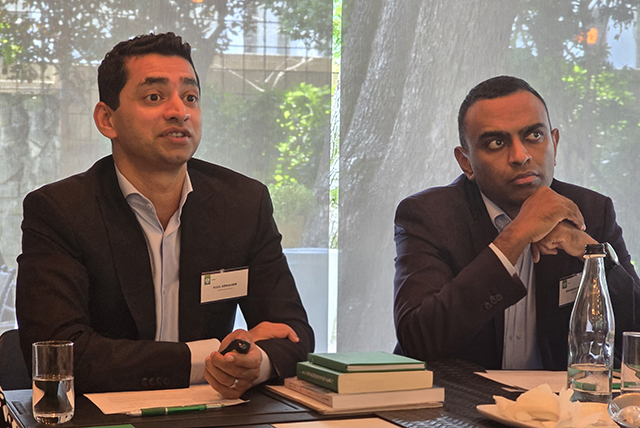
Incoming Old Mutual CEO Soul Abraham (left) and Ricardo Govender.
The climate conundrum
Another global trend with local impact is climate change.
Abraham pointed out that floods, fires and extreme weather events are occurring with increasing frequency and intensity, pushing insurers to rethink how risk accumulates and how capital is deployed.
In South Africa, the impact has been stark. The 2022 floods in KwaZulu-Natal alone resulted in insured losses running into the billions of rand, while wildfires in the Western Cape and severe hailstorms in Gauteng have become recurring features of the claims environment.
“The issue is not just severity, it’s frequency,” said Ricardo Govender, who heads risk, actuarial and sustainability functions at Old Mutual Insure.
“Historically, catastrophic losses were relatively flat, with occasional spikes. Over the past decade, the number of events has accelerated sharply,” he continued.
Compounding the challenge is the strain on infrastructure. Flood damage, for example, is exacerbated by ageing stormwater systems and informal settlements - the company noted that blankets from people sleeping in storm drains is the main reason that storm drains cannot cope with large amounts of rainfall. This amplifies losses well beyond what insurers would have expected from rainfall alone.
Climate risk is only part of the story.
The company explained that climate change is reshaping not only the severity of losses, but the way insurers understand accumulation of risk. It means they can no longer look at exposure in silos.
Instead of relying on postcodes or provincial boundaries, insurers are increasingly turning to asset‑level climate risk platforms that combine geospatial data, historical loss patterns and short‑term forecasting. These tools allow insurers to map exposure street by street, overlay flood plains or wildfire zones, and adjust pricing with far greater precision than was possible even a decade ago.
The shift reflects an industry shifting away from blunt exclusions towards more scientific, data‑driven approaches to insurability - and also echoes what IBM is doing in the climate space, as explored in Zurich towards the end of last year.
Technology in action
Another factor that is reshaping the risk landscape, unsurprisingly, is technology itself, particularly artificial intelligence.
If climate change is reshaping risk, technology is reshaping how insurers respond.
Abraham noted that short-term insurance is one of the most operationally complex financial services sectors, involving multiple lines of cover and extensive reliance on third-party service providers. That complexity has historically slowed digitisation.
But recent advances in data analytics and artificial intelligence are changing the equation.
“We sit with encyclopaedias of historical data,” said Abraham. “By moving that data into the cloud, we can finally allow AI to work with it.”
AI is already being used to enhance underwriting, pricing and fraud detection. Models can analyse unstructured data, identify unusual claims patterns and simulate how macroeconomic shocks might ripple through the business.
Most of the immediate value, however, is still emerging on the risk selection side. “That’s where the biggest gains are right now,” Abraham said. “Customer experience is the next frontier.”
The Limits and Risks of AI
Despite the enthusiasm, insurers are wary of over-reliance on artificial intelligence.
“There’s a real risk of bias, data leakage and lack of explainability,” said Govender. “These models are powerful, but they’re not transparent in how they arrive at answers.”
But Abraham revealed that AI is increasingly being used not to replace underwriting judgment, but to augment it. Insurers are deploying enterprise AI modelling platforms to simulate how unexpected shocks, from fuel‑price spikes to supply‑chain disruptions, might cascade through their books.
While the models can identify patterns far faster than humans, responsibility remains firmly with people. ''You can automate processes, but you cannot automate accountability,” stressed Govender.
That is not the only way technology is changing the landscape. Abraham pointed out that the engagements and rapid responses that people receive from their devices are also influencing the expectations of customers, who are increasingly expecting rapid, always-on responses.
He pointed out that the problem of competing with ChatGPT or Gemini for responsiveness is compounded by the fact that insurance companies frequently rely on a number of third parties when receiving a claim, from an independent plumber who is called out to fix a burst geyser, to the small business owner panel beater who fixes a car after an accident.
This makes addressing a claim convoluted and nuanced, which means that it may not be as quick as today's consumers’ demand.
And yet, that is still not all. In the insurance industry itself there is also another profound shift underway - a move from pure risk transfer to active risk prevention.
Using near real-time satellite data and predictive models, insurers can now identify wildfire and flood risks days in advance. That intelligence is being used not only to price risk, but to intervene.
In the Western Cape, insurers have partnered in a helicopter-based “quick reaction force” to assist firefighters during major wildfires. In 2025 alone, the initiative helped avert losses estimated at more than R1 billion.
“That’s value created before a claim even happens,” said Govender. “It changes the role of insurance entirely.”
Talent, Skills and the Human Challenge
Even as automation grows, the Old Mutual team stressed that people remain central to the industry’s future and are increasingly scarce. Across the board, the skills scarcity is a major challenge.
Actuaries, data scientists and engineers are in short supply globally, driving competition and salary pressure. In South Africa, Old Mutual shared, transformation within these professions has been slow, intensifying the challenge.
“This is not just an insurance issue,” explained Govender “These skills are needed across banking, healthcare and investments as well.”
At the same time, insurers face a delicate balance: automating efficiently while preserving the training grounds that produce future experts.
“If you automate everything, you don’t develop the next generation of judgment,” he cautioned.
A Cheaper, More Inclusive Future?
Looking ahead, industry leaders seem to be realistic about what technology can — and cannot — deliver.
It seems that the underlying sentiment is that AI is unlikely to permanently lift profit margins, with increased competition pushing savings back to customers. But that may be precisely spell the opportunity the industry needs.
“If we can reduce costs meaningfully,” Abraham said, “we can make insurance cheaper and dramatically improve penetration in South Africa.”
In a country where economic losses from disasters far outweigh insured losses, that shift could be transformational.
“The challenge is building an industry that’s resilient enough to absorb climate shocks, fast enough to adopt new technology, and inclusive enough to protect more people,'' concluded Abraham.
Enjoyed this? Don’t stop here.
I explore the human side of AI, technology, and the future of income in a way that’s actually useful.
For a deeper, more personal look at what doesn’t make it into the article:
👉 Join me on Substack (for deep dives)
👉 Join my WhatsApp Group (for real conversations)
Most Read Articles
 Lenovo introduces Legion gaming phone for gamers looking for 5G, powerful perfor...
 Logitech Wireless Solar Keyboard K750
 The modern influence of retrogaming
 Xiaomi Redmi Note 10S


Have Your Say
What new tech or developments are you most anticipating this year?