WBBA Broadband Development Conference 2025 highlights Broadband and AI's role in the future of Africa
By Staff Writer 12 November 2025 | Categories: news
Related Articles
 Your IT team does not need another dashboard, it n...
 Engineering for density – why liquid cooling is...
 Energy for AI, AI for energy: designing AI-ready d...
The recent WBBA Broadband Development Conference (BDC) Cape Town 2025 has concluded successfully, having explored not only the importance of broadband growth on the continent, but also Artificial Intelligence's role in securing Africa’s future.
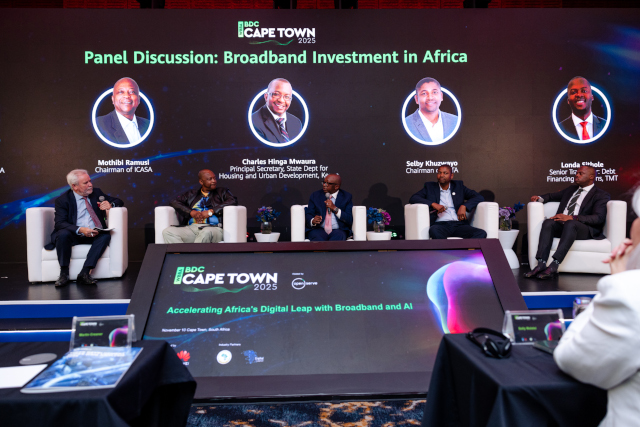
The BDC conference brought together more than 150 officials, executives and technology experts under the theme “Accelerating Africa’s Digital Leap With Broadband and AI”. It served as a key platform for sharing insights on policy, innovation and investment, a day before the African Tech Festival, currently underway in Cape Town, started.
Discussions centred on, amongst others, how robust fibre networks provide the foundation for deploying AI-driven solutions tailored to Africa’s unique challenges and opportunities.
In his opening remarks, director general of the World Broadband Association (WBBA), Martin Creaner, noted that, historically, a nation’s prosperity relied on essentials such as roads, clean water and electricity. However, broadband excellence has now become an equally vital precondition for economic growth.
He outlined one of the WBBA’s major joint initiatives: defining the broadband roadmap for the next decade. This roadmap goes beyond higher access speeds, also considering improvements in latency, reliability, availability and security, there to advance the next generation of digital services, including AI.
In a keynote address, South African Minister of Communications and Digital Technologies, Solly Malatsi, noted that while broadband forms the backbone of growth, it is AI that is the driver that turns access into impact. Malatsi believes that for AI to work for Africa, it must function in local languages, on local data and for the improvement of those on the continent.
“We need to develop responsible, African-fit AI. We must build models that reflect our realities by supporting researchers and startups with the datasets and compute they need,” Malatsi said. This sentiment was reflected by Hover Gao, Huawei’s president for the Sub-Saharan Africa region, speaking earlier the day at the Ministerial Forum. Gao called for African countries to prioritise the development of national computing power centres and for the creation of nation’s own foundational AI models, which include local knowledge and languages.
In his keynote address at the BDC, Huawei’s Bob Chen, president of the Optical Business Product Line, outlined a three-phase model for broadband growth in Africa. The first phase focuses on expanding fibre coverage to increase the user base; the second on upgrading network speeds to raise average revenue per user; and the third on enhancing user experience through high-quality Wi-Fi and smart home services. Chen suggested that African operators could adopt this phased approach to sustain long-term broadband development.
During the event, Huawei also announced the launch of its Southern Africa FTTx Planning & Design Service Centre to accelerate the region’s fibre deployment.
Also talking at the BDC was Dr. Sunil Piyarlall, executive at Openserve, who emphasised that the discussion for the continent must go beyond internet access to further focus on quality, resilience and equitable reach. He noted that solutions such as Openserve’s Fibre-to-the-Room are shaping the next frontier of home and business connectivity, making it seamless and future-proof.
The conference concluded with the presentation of the Gigacity Certification Awards, recognising leading contributors to Africa’s high-speed digital infrastructure: Openserve (South Africa), Safaricom (Kenya), TTCL (Tanzania), and the State Department for Housing and Urban Development of Kenya.
Most Read Articles
 Canon updates the Connect Station CS100 for more opportunities to store and shar...
 Logitech Pebble 2 Combo
 WD My Cloud EX2 NAS launched
 LG 75-inch QNED 4K UHD 120Hz Smart TV
 Samsung Galaxy S4 Zoom - white
 The AI Revolution in Real Estate: Transforming Estate Agents
 Quick Review: Tecno Spark10 5G


Have Your Say
What new tech or developments are you most anticipating this year?