Huawei pushes AI-driven networking at IP Club 2026 event
By Staff Writer 27 March 2026 | Categories: news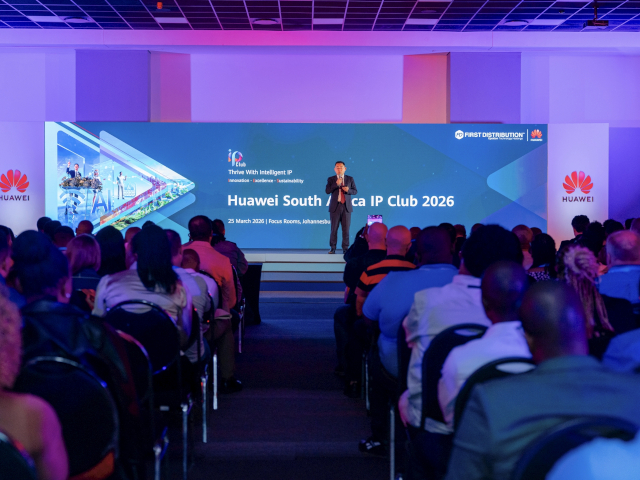
Related Articles
 rAge and Mettlestate join forces to shape South Af...
 Why Africa's fastest AI adopters need governance, ...
 (1)-2.jpg) Cloud is not the real infrastructure question anym...
Cloud is not the real infrastructure question anym...At MWC26 we saw Huawei using AI to create AI-Centric Network solutions that will act as target networks for the agentic era. It's no wonder then that the focus locally is also AI, with Huawei South Africa having now showcased its Xinghe portfolio of AI-driven networking solutions at its IP Club 2026 event.
The event took place in Modderfontein in Johannesburg and drew more than 450 attendees. It showcased how the company is moving AI-driven networking from theory to deployment, with an integral part of this being its Xinghe portfolio. According to Huawei, this is a suite of AI-driven solutions designed to secure and optimise enterprise networks.
A key focus of the event was Huawei’s AI Campus approach, which combines existing network infrastructure with AI-driven tools such as iMaster NCE and NetMaster. Together, these systems detect threats automatically while improving network performance and security.
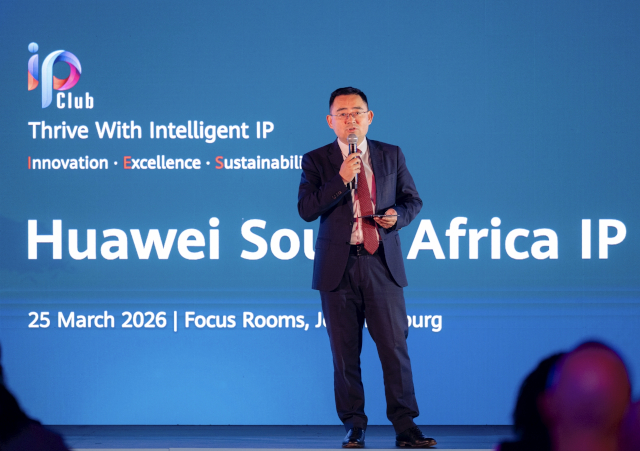
Kui Zheng, CEO of Huawei Enterprise South Africa
Security in the age of AI
And security was indeed one of the main concerns addressed by speakers at the event. In his opening speech, Kui Zheng, CEO of Huawei Enterprise South Africa, highlighted how Huawei is focusing on secure and future-ready network solutions. “Everywhere we look, people are using AI. AI makes our business faster, smarter and better. But, as network and IT leaders, we know the truth: AI also brings new dangers.” One of the biggest cybersecurity threats, Zheng explains, is ransomware. And the drive behind these crimes is financial gain.
Expanding on this, Yanjun Yu, senior principal architect at the AnShi Lab, Edison Research Center at Huawei Technologies Canada, pointed to how cybercrime has evolved into a structured economy. “Nowadays, most cybercrimes are driven by financial gain. Organised cybercriminals operate like thriving businesses. They offer many different types of services, for example, malware as a service and ransomware as a service.”
Yu noted traditional network architectures were built around a single central system, but companies have since adopted hybrid work models. Businesses now operate across diverse cloud and remote environments, which makes security harder to enforce and systems easier to exploit.
Huawei Xinghe AI Unified SASE Solution
Han Wu, product manager at Huawei Southern Africa ICT Marketing & Solution Sales, said the rise of AI is making an already complex security environment even harder to manage. With multi-cloud systems and a remote workforce, the traditional perimeter model is losing relevance fast.
Han explains, “The traditional defense method of focusing on the data and data centres can no longer meet the needs of the traditional and frequent service success.” She says in this new environment, Huawei is using AI to build an all-scenario intelligent protection system for customers.
One of the solutions presented at the event was Huawei’s Galaxy AI Fusion SASE, which the company notes uses an “AI vs. AI” approach: using AI to detect and respond to cyber threats powered by AI. The system connects networks in a business and protects it without slowing operations down or relying too heavily on human intervention.
According to Huawei, Galaxy AI Fusion SASE is used across sectors including government, transport, finance and education, with it having been proven to reduce risk, cut complexity and maintain consistent security across remote users and data centres.
Xinghe portfolio overview
Huawei positioned its approach as spanning multiple layers of enterprise infrastructure, from campus networks to WAN and data centre environments.
-
AI Campus: Builds secure and intelligent campus networks using AI to improve user experience and integration across environments.
-
Intelligent WAN: Provides a secure and intelligent network foundation that connects distributed environments, with built-in automation and security to support performance and reliability at scale.
-
AI Fabric: Supports always-on data centre networks with enhanced automation and intelligent operations to improve reliability and performance.
-
Unified SASE: Delivers AI-powered, end-to-end security across networks, addressing evolving cyber threats through more adaptive and integrated protection.
IP Club going forward
Huawei believes its IP Club initiative helps improve skills development and innovation, while helping organisations strengthen and modernise their networks. The company is expanding its IP Club community through a structured member recruitment programme, designed to bring together ICT professionals to connect, learn and exchange expertise in the IP domain.
Most Read Articles
 AI, syndicates, Nation-states - As technology converges, so too does cybercrime
  Blockchain to unlock real value for South African sport
 The thing about millennials and technology
 WRC FIA World Rally Championship 2
 ManageEngine rolls out autonomous AI capabilities across its suite to power digi...
 Logitech Pebble 2 Combo
 Samsung Galaxy S4 Zoom - white
 Quick Review: Tecno Spark10 5G


Have Your Say
What new tech or developments are you most anticipating this year?