Microsoft Surface sharpens it play for businesses, with AI at the core
By Ryan Noik 21 September 2026 | Categories: news
Related Articles
 Vodacom Bulls and PUMA introduce third kit exclusi...
 OPPO South Africa launches online store for local ...
 Xiaomi launches REDMI Note 17 series in South Afri...
At a recent event held by the Core Group, the company unveiled the new range of Microsoft Surface.
The company was excited to reveal that the Core Group has now become the exclusive distributor for the devices in South Africa.
This, the company explained, is being met with a strengthened commitment keep stock available locally, support competitive and consistent pricing, strengthen after-sales service and help resellers create demand for a premium device family that is still carving out space in a crowded Windows market.
John Press, business unit head for Microsoft Surface at Core Group, acknowledged that Surface is not positioned as the cheapest option. Its appeal, he argued, lies in the “sum of the parts,” which includes industrial design, carefully selected materials, high-quality displays, tactile polish, software integration and business-ready support.
Even in some cursory time with the devices, I could certainly feel that it is a premium product, and the attention to detail in its build quality. Like an expertly prepared meal, you can feel the difference when a product, whether it is hardware or software, has been given significant attention to detail, and that is true of the new Surface devices that I briefly played with.
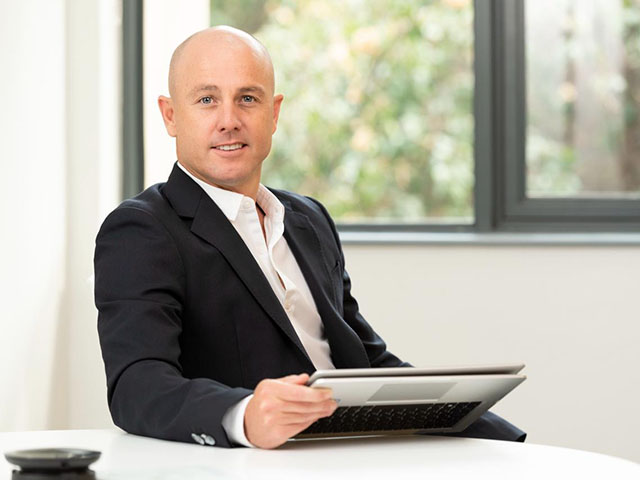
John Press
Press explained that the display is a central part of that experience, with the Surface Pro’s 3:2 aspect ratio gives users more vertical working space than a conventional widescreen panel, and also making the Surface an outlier, when most manufacturers favour a 16:9 aspect ratio.
However, he added that high-resolution PixelSense touchscreens, precise multi-touch input and pen support, at least on compatible models, reinforce the idea that the screen is not merely something to view, but a working surface for writing, drawing and touch navigation.
Down to business
Surface’s business case extends beyond its physical construction. Being a Microsoft product, obviously users get a tighter integration with Microsoft’s Windows 11 OS.
Where this becomes a potential selling point is for businesses equipping many staff with the Surface device. Press explained that Windows Autopilot and Intune are intended to help organisations ‘’streamline deployment, management and support at scale.’’
Autopilot enables IT departments to provision a device remotely with minimal user interaction, while Intune gives administrators the ability to apply policies, install applications, monitor compliance and manage endpoints centrally. For organisations with distributed workforces, the result is less manual setup and more consistent control from the moment a device is switched on, he explained.
AI, inevitably
If you were thinking finally, an article that doesn’t mention AI, here is where I must disappoint you.
On-device artificial intelligence has become the one phrase you can’t escape if looking for a PC or for that matter many smart devices today. And that is also why new PCs increasingly include a neural processing unit, or NPU, dedicated to AI workloads, as part of their spec sheet.
As I understand it, processing AI locally can reduce latency, allow selected tools to work without an internet connection and keep sensitive data on the machine rather than sending it to the cloud. Those benefits are especially relevant in highly regulated industries and in environments where connectivity is unreliable.
There is also a commercial argument. Cloud-based generative AI can create unpredictable spending as token consumption rises. Press cited the example of a large bank whose monthly token bill had exceeded R3 million. While moving repetitive or specialised workloads onto local hardware will not eliminate cloud AI, but it can help organisations allocate it more selectively. A credit-risk assessment demonstration illustrated the point: customer data and a local model were used to explore lending scenarios and produce recommendations on the device, potentially accelerating decisions while limiting data exposure.
And, given that cybercriminals are increasingly using AI to try steal data at scale too, limiting data vulnerabilities is a VBG (Very Big Deal).
What to expect
The mainstream portfolio remains centred on two familiar form factors. Surface Pro offers the flexibility of a tablet and laptop in one device, including a compact 12-inch option alongside the established 13-inch class.
The Surface Laptop is aimed at users who prefer a traditional clamshell design, with 13.8-inch and 15-inch business models, with the latter being what I would personally be the size I would gravitate towards (sorry, 13.8 is still too small a screen size in a laptop for my eyes to handle comfortably). And in my experience, a 15 inch screen is still very comfortable to carry as a travel ready device.
Across the range, the emphasis is on newer Intel and Snapdragon processors, increasingly capable NPUs, improved haptics, multi-monitor support and long battery life. Depending on the model and test scenario, Microsoft quoted battery lives that stretch from a working day into roughly 20 hours or more, although as is always the case, real-world results will vary with usage and configuration.
Not quite content with showing us the latest devices, the Core Group also teased that there ia another category on the horizon - the Surface Laptop Ultra. This, Press explained, is aimed at creators, developers and other professionals with demanding local workloads. Microsoft has positioned the machine around NVIDIA Blackwell RTX graphics, full CUDA support, up to one petaflop of on-device AI compute and as much as 128GB of unified memory.
That combination is intended for tasks such as running large AI models locally, 3D rendering, compiling complex projects and managing multiple intensive workflows without depending entirely on cloud infrastructure.
For South African buyers, final pricing, configurations and availability are still to be confirmed closer to release, so the Ultra should be treated as a statement of direction rather than an immediately available product. Even so, it broadens the Surface proposition significantly.
What became clear at the event is that the Surface brand is no longer speaking only to mobile productivity; but rather is making a case for the PC as a secure, privately managed AI platform with enough local compute to change how professional work gets done.
Most Read Articles
 Trailers you have missed this past weekend (10-12 March)
 Manage contact centre pressure with gamification
 Time, Comfort and Connection: The Root of Future Devices
-2.jpg) Aruba advances mobile first architecture to enable autonomous networking and the...
Aruba advances mobile first architecture to enable autonomous networking and the... Logitech Pebble 2 Combo
 Samsung Galaxy S4 Zoom - white
.jpeg) Beware of deepfakes in the AI age, warns Kaspersky
Beware of deepfakes in the AI age, warns Kaspersky VAT Modernisation: The next test of South Africa’s digital readiness


Have Your Say
What new tech or developments are you most anticipating this year?